Posts

Showing posts with the label Borland Genetics

Reconstructing My Great-Grandparents (As The Creeper Tour Rolls On)
Image
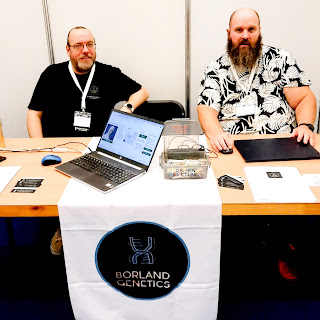
Kevin and Rolf exhibiting Borland Genetics in Sweden As many readers may be aware, Borland Genetics has been promoting uploads to the site throughout 2022 via a hybrid in-person/virtual string of appearances at industry tradeshows, genealogy society events, genealogy vlogs, etc., all under the penumbra of the "2022 Creeper Tour."  So far, the tour has passed through Baltimore, Cincinnati, Sacramento, Ottawa, Indianapolis, Portland (Oregon),  Skövde (Sweden), and Burbank, and upcoming dates are scheduled for Minneapolis (virtual), Sydney (Australia), Salt Lake City, Richmond, Sandusky, Milwaukee, and finally back to Baltimore (as the Tour extends through 2023). Some of the dates thus far  have been expo hall exhibits with opportunity to meet me in-person and discuss Borland Genetics reconstruction techniques, while others took the form of virtual talks where I presented topics including DNA inheritance, DNA reconstruction, interpreting one's DNA results, the future of DNA ...

Introducing the Borland Genetics Segment Lab

Image
  It occurred to me today that I have not yet done a tutorial on how to use the Borland Genetics “Segment Lab” tool.   Introduced as part of last October’s anniversary “Fall Features Release,” it’s one of the newest tools on the site, and probably also one of the most under-utilized.   Hopefully, this demonstration will show how it’s also one of the most valuable tools on the site. The Segment Lab is Borland Genetics’ native chromosome map/phase map editor.   While a far cry from a robust chromosome mapping solution like DNAPainter, it has specialized features that I designed to make our task of ancestor DNA reconstruction easier, and to help maximize the reconstruction coverage of our output ancestor kits. Before we dive into using the tool, I want to point out that the Segment Lab is NOT a tool that creates a phase map from scratch.   At Borland Genetics, that’s what the HIR Mapper does, and when it comes to mapping matches from outside the Borland Genetic...
Image
What's the Difference Between Build 36 and Build 37, and Should I Care? To even begin to tackle this problem, we’re going to first need to understand what a “build” is.   Perhaps you may have seen references to “build 36” or “build 37” on FTDNA or GEDmatch or Borland Genetics, or to “build 38” on SNPedia.   Never heard of SNPedia?   We’ll cover that in future editions in this blog.   But to get to the point, when you hear these terms, we are referring to sequential versions of the accepted map of the human genome by the scientific community (or a dedicated group of scientists thereof known as the Genome Reference Consortium).   Each build represents a refined understanding of the sequence of base pairs along our chromosomes. A loose analogy to build versions would be the sequential editions of the Rand McNally road atlas, but with one major difference.   When Rand McNally publishes subsequent editions of its atlas, it generally does so becaus...
Image
Why You Should Merge Your Factory DNA Kits:   SNP Overlap Demystified In this blog, I want to briefly discuss why it is best practice to merge your factory kits from different testing companies prior to working with third party raw DNA tools such as Borland Genetics or GEDmatch.   By factory kits, I simply mean raw DNA data files that were created directly by the testing companies by processing actual DNA samples. The first concept to understand is that different testing companies sample different sets of data points along your chromosomes.   We refer to the totality of the data points sampled in a single DNA kit that kit’s “template.”   Furthermore, individual testing companies have changed their chips over the years, also resulting in different kit templates.   When you hear people talking about an Ancestry v1 or Ancestry v2 or 23 & Me v4 kit, they are referring to their tests by their template revision version.   The ISOGG Wiki does...
Image
If I match Cousin A and Cousin B on chromosome 6, does that mean that we share a common ancestor? The answer is a bit complicated! First, the general answer: General rule:  If you and cousin A and cousin B all match across a significantly overlapping span of the same copy of the same chromosome (called a segment), it is highly probable that you do so because the three of you all inherited that segment from a common ancestor. But what does that mean? First qualification :  It's not enough that the matches both match you on the same chromosome.  The matches must also match you over the same span of that chromosome.  Position on a chromosome is generally measured in MBP or Mega-Base-Pairs.  If Cousin A matches you on chromosome 6, but over the span of 23 MBP to 51 MBP, but Cousin B matches you over the span of 63 MBP to 81 MBP, this is not evidence that you and both matches share a common ancestor because these are segments to do not overlap....